
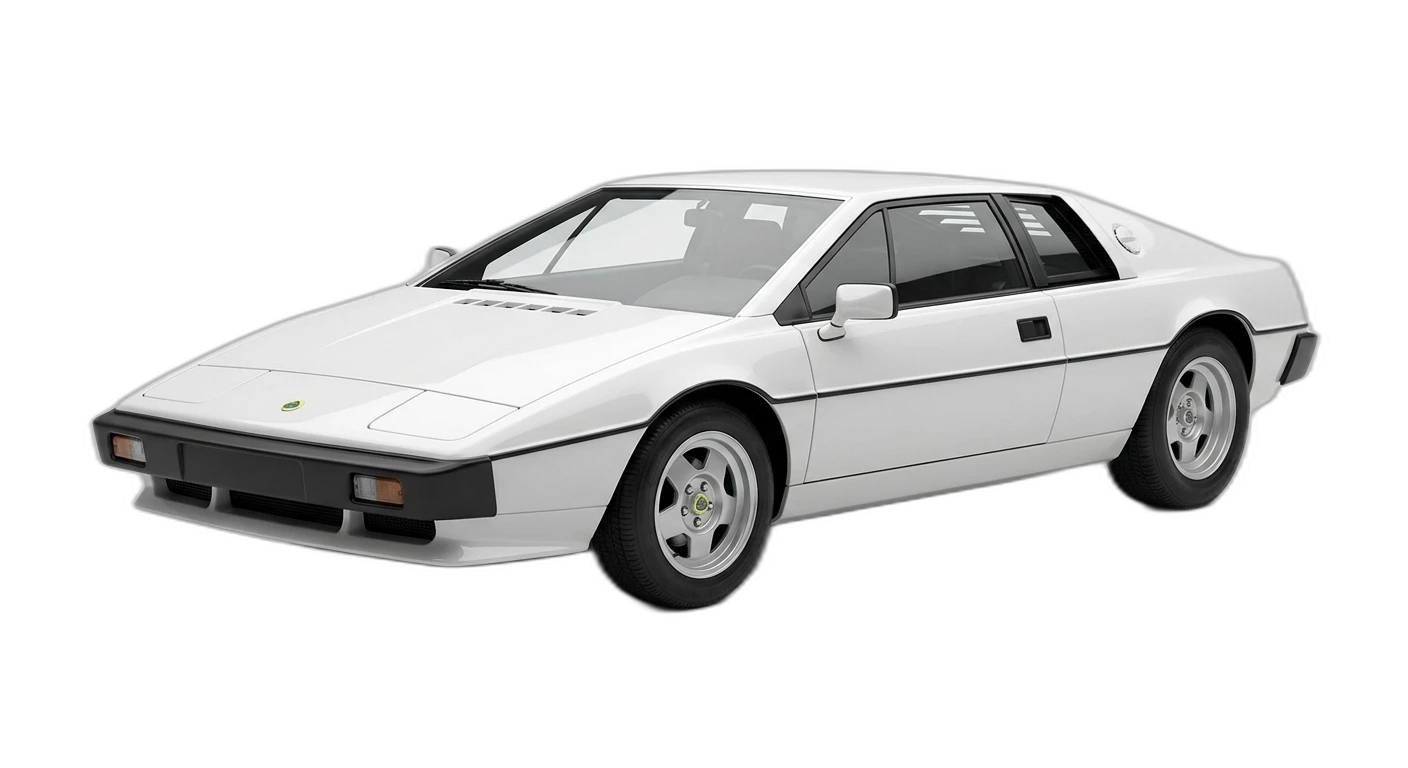
Giugiaro's folded-paper masterpiece. Became a submarine in The Spy Who Loved Me, giving it cultural immortality. The wedge shape defined 1970s supercar design. Four generations over 28 years, evolving from naturally aspirated four-cylinder to twin-turbo V8.
History
Colin Chapman commissioned Giorgetto Giugiaro to design a mid-engine sports car that would elevate Lotus from kit-car builder to supercar manufacturer. Giugiaro responded with one of the most radical shapes of the 1970s: a pure wedge built entirely from straight lines and sharp creases.
The Series 1 Esprit debuted in 1976 with Lotus's own 2.0-liter four-cylinder engine producing 160 hp. The car was light (900 kg in early form) and handled with the precision expected of a Lotus, but the engine was modest compared to Italian V8s.
The Spy Who Loved Me (1977) transformed the Esprit from a niche sports car into a cultural icon. The white S1 driven by Roger Moore that converted into a submarine is one of the most famous movie cars ever. Elon Musk bought the actual prop car for $866,000 at auction.
The Esprit Turbo (1980) addressed the power deficit with a turbocharged engine producing 210 hp. Peter Stevens redesigned the body for the 1987 model, rounding Giugiaro's sharp edges. The final V8 variant (1996-2004) used a 3.5-liter twin-turbo V8 producing 500 hp.
Across 28 years and 10,675 units, the Esprit remained true to Chapman's philosophy: lightweight, mid-engine, and uncompromised in handling.
Timeline
Production & Heritage
Value estimates are editorial assessments based on recent auction results and market trends.
Technical Specifications
Engine Details
Performance
Tags
Designed by Giorgetto Giugiaro
From the 1970s
Featured in Collections
References & Sources


More in Sports
See all
356 Pre-A
356 Speedster
XK120