
Giulietta Sprint
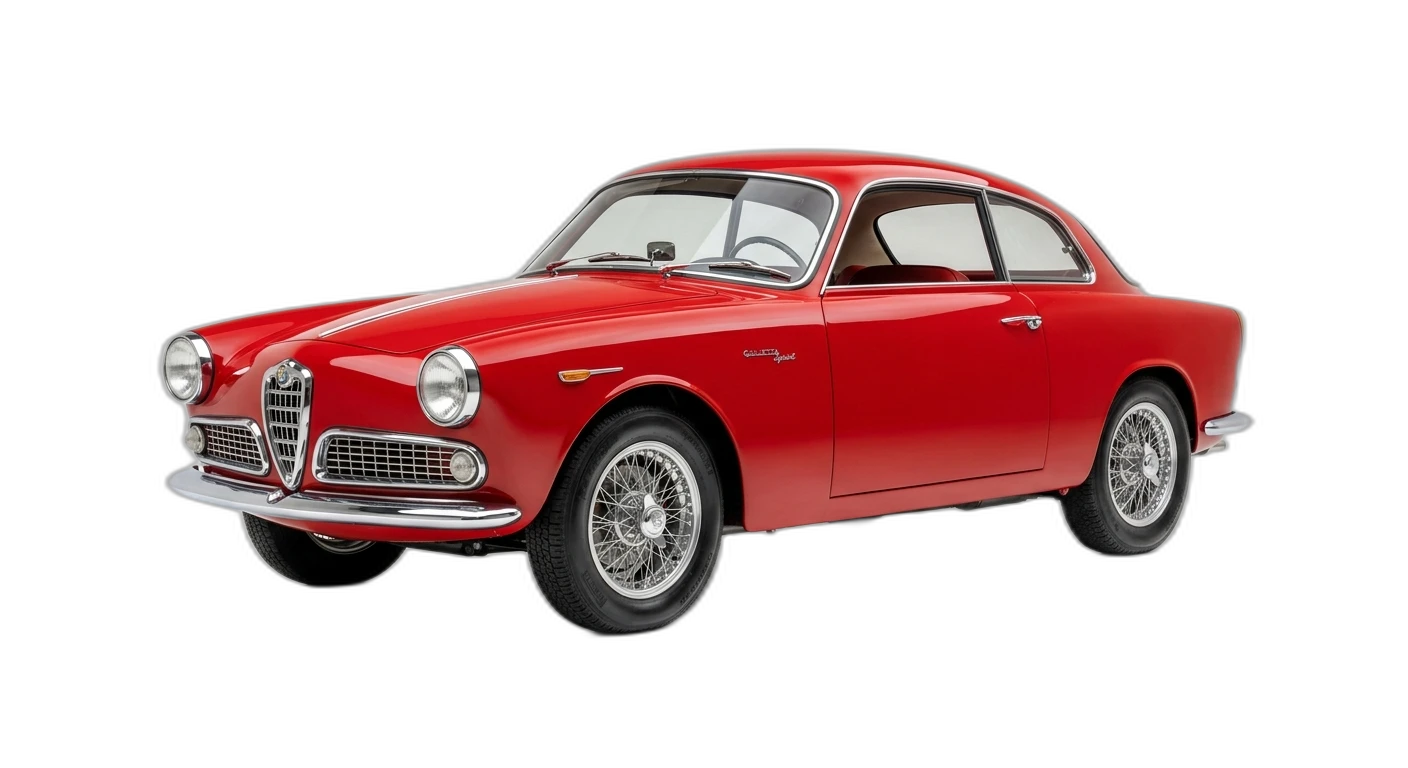
The Giulietta Sprint was the car that democratized Alfa Romeo ownership, bringing twin-cam performance and elegant Bertone coachwork to the middle class for the first time. It launched the legendary Giulietta family and established the template for the affordable sporting Alfa Romeo.
History
The Alfa Romeo Giulietta Sprint, introduced at the Turin Motor Show in 1954, was a car of enormous significance for both Alfa Romeo and the broader Italian automotive industry. Before the Giulietta, Alfa Romeo was primarily a manufacturer of expensive, hand-built grand touring cars and racing machines — beautiful and technically sophisticated, but accessible only to the wealthy. The Giulietta changed everything. Here was a car that offered genuine Alfa Romeo engineering quality, twin-cam engine performance, and stunning Bertone coachwork at a price that a professional or successful tradesperson could aspire to own. It was, in many ways, the car that created the modern Alfa Romeo brand.
The Sprint coupe was actually the first Giulietta variant to reach the market, preceding the sedan version. Designed by Franco Scaglione working under Nuccio Bertone, the Sprint's body was a masterpiece of compact elegance — perfectly proportioned, beautifully detailed, and timeless in a way that few 1950s designs have proven to be. Under the skin was Alfa Romeo's new 1,290cc twin-cam four-cylinder engine, a design by Giuseppe Busso that would evolve and grow over the following decades to become one of the most celebrated engine families in automotive history. In the Sprint, it produced 65 horsepower initially, later rising to 80 horsepower in the Sprint Veloce version — enough to propel the lightweight coupe to a genuine 165 km/h.
The Giulietta Sprint proved enormously popular, both commercially and in competition. On the road, it offered a driving experience that was refined yet engaging, with precise steering, a willing engine, and a level of sophistication that belied its modest price. In racing, the Giulietta Sprint and its Veloce variant proved highly competitive in their class, winning countless races in the hands of both professional and amateur drivers. The car's success spawned an entire family — the Giulietta Spider, designed by Pininfarina, and the Giulietta sedan — that collectively transformed Alfa Romeo from a niche manufacturer into a volume producer.
Total production of the Giulietta Sprint reached over 24,000 units across its production run from 1954 to 1965, a remarkable number for Alfa Romeo at the time. The car was succeeded by the Giulia Sprint GT in 1963, which continued and refined the formula that the Giulietta Sprint had established. Today, the Giulietta Sprint is revered as one of the most important postwar Italian automobiles — a car that changed the course of Alfa Romeo's history and brought the joy of Italian motoring to a generation of enthusiasts. Well-restored examples are increasingly valuable, particularly the early 750-series cars with their distinctive features, while the Sprint Veloce variants command a premium for their enhanced performance.
Timeline
Production & Heritage
Value estimates are editorial assessments based on recent auction results and market trends.
Technical Specifications
Engine Details
Performance
Dimensions
Chassis & Suspension
Drivetrain
Capacity
Tags
Designed by Franco Scaglione / Bertone
From the 1950s
Featured in Collections


More in GT
See all
300 SL Gullwing
P1800

DB5