
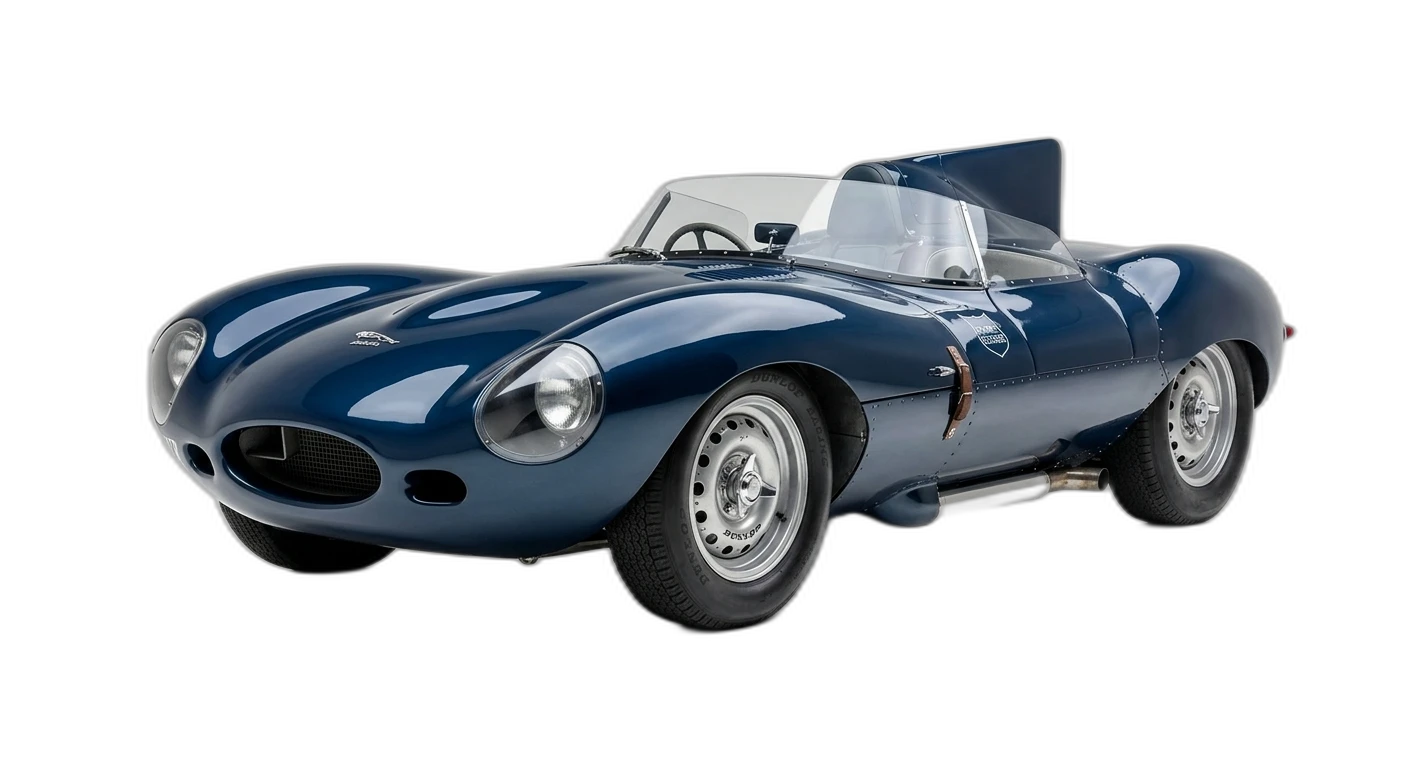
Le Mans triple winner (1955, 1956, 1957). Malcolm Sayer used aircraft aerodynamic principles to design the first car with a monocoque center section. The stabilizing fin behind the driver's head was derived from aircraft design. Only 71 built.
History
Malcolm Sayer, Jaguar's aerodynamicist, designed the D-Type using the same mathematical modeling he had learned working on aircraft at Bristol. The result was the most aerodynamically advanced racing car of the 1950s.
The central monocoque tub was fabricated from riveted aluminum alloy, with the engine and front suspension mounted on a tubular subframe. The distinctive stabilizing fin behind the driver's head reduced yaw at high speeds on the Mulsanne Straight.
The D-Type won Le Mans three consecutive years: 1955 (despite the disaster that killed 83 spectators when a Mercedes struck a D-Type), 1956 (Ecurie Ecosse), and 1957 (five D-Types finished in the top six). No car dominated Le Mans more completely.
The XK inline-six engine, with dry-sump lubrication and three Weber carburetors, produced 250 PS from 3.4 liters. The D-Type could reach 178 mph on the Mulsanne Straight.
Only 71 were built, including 16 XKSS road-legal versions (one owned by Steve McQueen). D-Types now sell for GBP 3 to 10 million at auction.
Timeline
Production & Heritage
Value estimates are editorial assessments based on recent auction results and market trends.
Technical Specifications
Engine Details
Performance
Dimensions
Chassis & Suspension
Capacity
Source: Jaguar / Wikipedia
Tags
Designed by Malcolm Sayer
From the 1950s
Featured in Collections
References & Sources


More in Racing
See all
SSK
550 Spyder
250 GTO