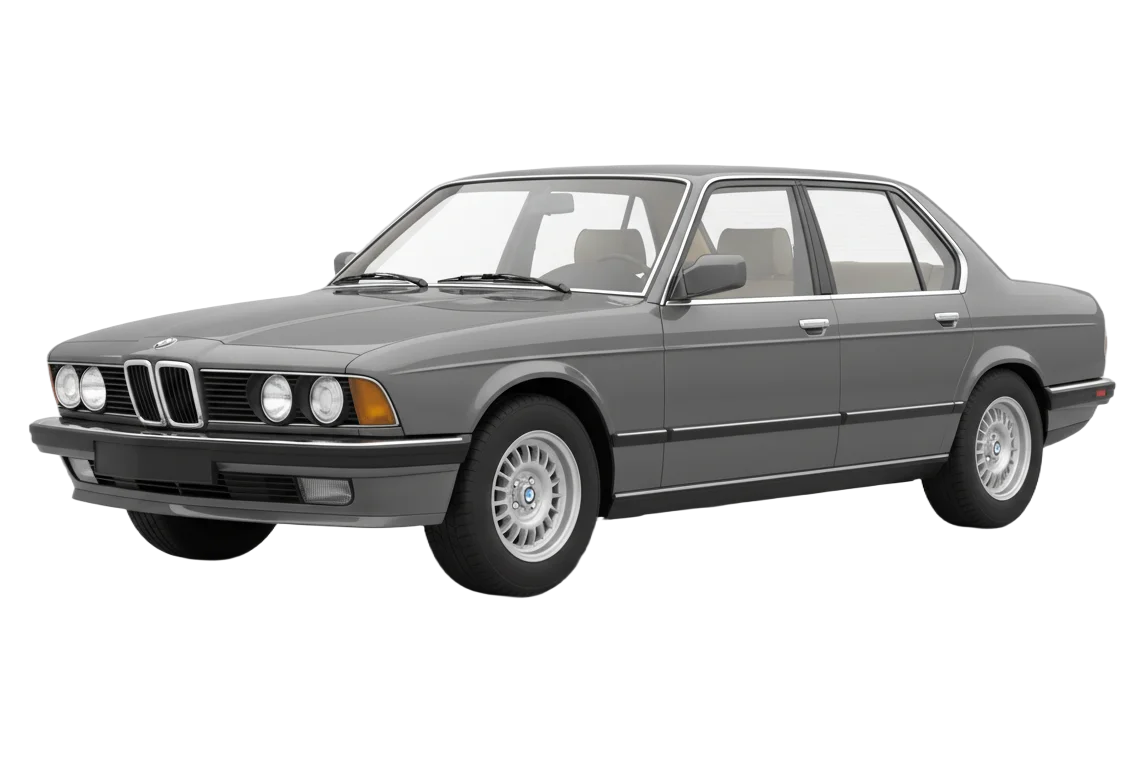
The BMW E23 was the first 7 Series and BMW's first true flagship luxury sedan, directly challenging the Mercedes-Benz S-Class. It established BMW as a credible competitor in the full-size luxury segment and introduced technologies that would trickle down to the broader BMW range.
History
The BMW E23 7 Series, launched in 1977, represented a bold strategic move by BMW into territory long dominated by Mercedes-Benz. For the first time, BMW offered a full-size luxury sedan that directly targeted the S-Class, signaling the company's ambition to compete across all segments of the premium market. Designed by Paul Bracq, the E23 combined the sporting character BMW was known for with the space, comfort, and refinement expected of a luxury flagship.
The E23 was initially offered with inline-six engines, including the 2.8-liter and 3.0-liter M30 units, but the most significant addition came in 1980 with the 745i. In European markets, this model featured BMW's first production turbocharged engine, the M106 3.2-liter turbocharged inline-six, while South African market cars received a unique 3.5-liter version. The 745i designation cleverly implied performance equivalence with a theoretical 4.5-liter naturally aspirated engine, establishing BMW's approach to naming turbocharged models.
Technologically, the E23 was a showcase for BMW innovation. It was among the first production cars to offer an on-board computer, providing information on fuel consumption, estimated range, and outside temperature. ABS brakes became available as an option, as did air conditioning and an advanced climate control system. The E23 also introduced features like check control, which monitored various vehicle systems and alerted the driver to malfunctions.
During its nine-year production run, approximately 285,000 E23s were built. While this was a fraction of S-Class sales, the 7 Series successfully established BMW as a legitimate luxury marque and provided a halo effect that benefited the entire brand. The E23 proved that a luxury sedan could offer a distinctly sporty driving character, differentiating BMW from the comfort-focused approach of Mercedes-Benz and setting a template that the 7 Series would follow for decades.
Timeline
Production & Heritage
Value estimates are editorial assessments based on recent auction results and market trends.
Technical Specifications
Engine Details
Performance
Dimensions
Chassis & Suspension
Drivetrain
Capacity
Source: BMW AG / Wikipedia
Tags
Designed by Paul Bracq
From the 1970s
Featured in Collections
References & Sources


More in Sedan
See all
Traction Avant
DS 21 Pallas