


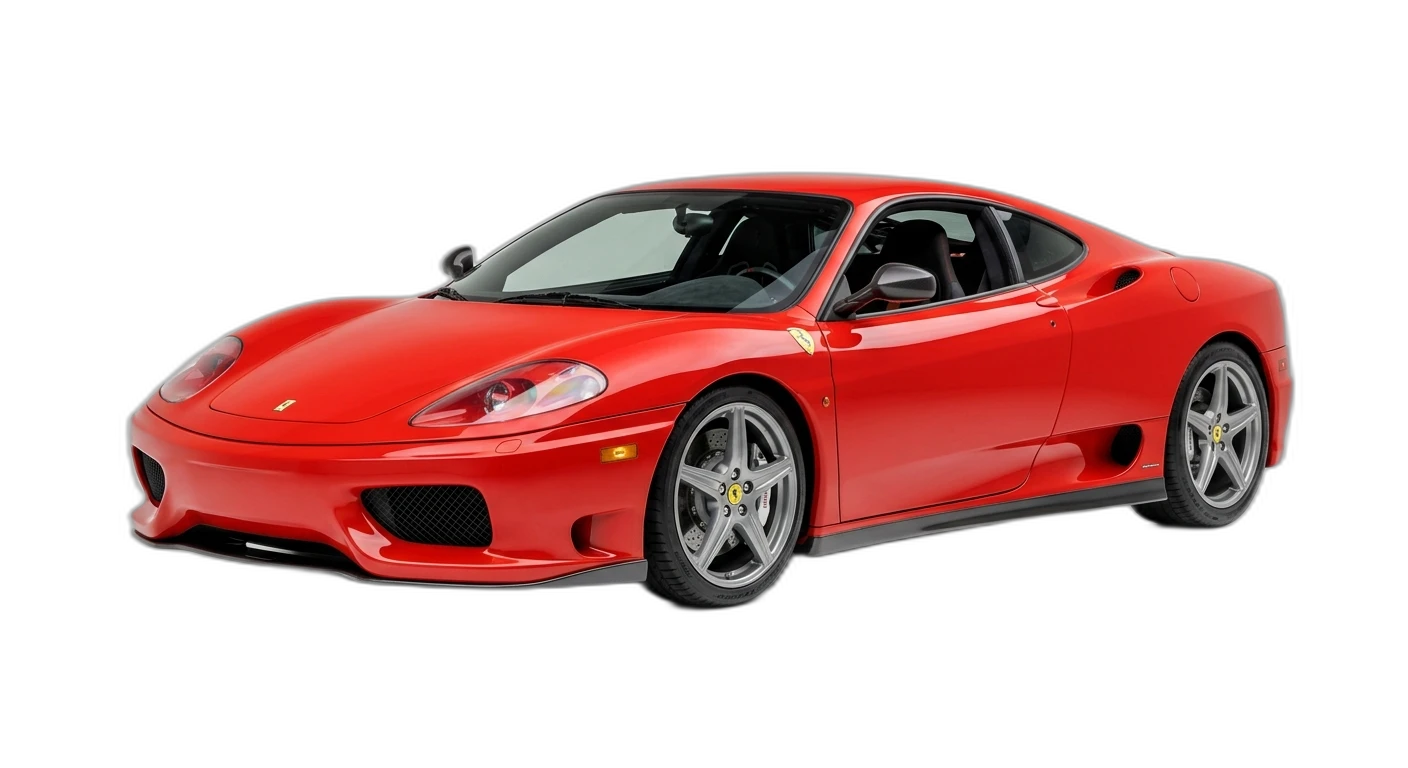
The Challenge Stradale was the first modern Ferrari to apply radical weight reduction and track-focused engineering to a production V8 model, creating a template that would later produce icons like the 430 Scuderia and 458 Speciale. It bridged the gap between road car and racing machine.
History
The Ferrari Challenge Stradale, introduced at the 2003 Geneva Motor Show, was a track-focused derivative of the 360 Modena that took its name from the Ferrari Challenge one-make racing series. The concept was straightforward: strip the 360 of unnecessary weight, enhance its aerodynamics, and tune its engine and chassis for maximum performance. The result was a car that weighed approximately 110 kilograms less than the standard 360, achieved through the use of carbon fiber body panels, lightweight Lexan rear window, a simplified interior, and the deletion of sound-deadening material.
The 3.6-liter V8 engine received attention as well, with optimized intake and exhaust systems boosting power to 425 horsepower at 8,500 rpm, a significant increase over the standard 360's 400 horsepower. The F1 automated manual gearbox received faster shift calibration, reducing shift times to just 150 milliseconds, while the suspension was stiffened and lowered. Carbon-ceramic brakes, derived from Ferrari's Formula One program, were standard equipment, representing one of the earliest applications of this technology on a production car. The CST (Controllo Stabilita e Trazione) system was recalibrated to allow more aggressive driving before intervening.
On the road and track, the Challenge Stradale delivered an experience that was dramatically different from the standard 360 Modena. The reduced weight and increased power created a more urgent, responsive machine, while the stripped-out cabin amplified the mechanical sounds of the V8 engine and the carbon-ceramic brakes. The car's exhaust note, in particular, was widely praised as one of the finest sounds produced by any Ferrari, with a high-pitched, penetrating wail that peaked above 8,000 rpm.
With 1,199 units produced during its brief 2003-2004 production run, the Challenge Stradale established a formula that Ferrari would refine and perfect in subsequent generations. Its success demonstrated that there was strong market demand for lightweight, track-oriented variants of Ferrari's V8 sports cars. Today, the Challenge Stradale is regarded as one of the best-driving modern Ferraris, with values that have appreciated significantly as the market has recognized its significance as the progenitor of Ferrari's now-essential 'Speciale' sub-brand. It remains a favorite among driving purists who prioritize engagement and sensory intensity over outright power.
Timeline
Production & Heritage
Value estimates are editorial assessments based on recent auction results and market trends.
Technical Specifications
Engine Details
Performance
Dimensions
Chassis & Suspension
Capacity
Source: Ferrari / Wikipedia
Tags
Designed by Pininfarina
From the 2000s
References & Sources


More in Sports
See all
356 Pre-A
356 Speedster
XK120