
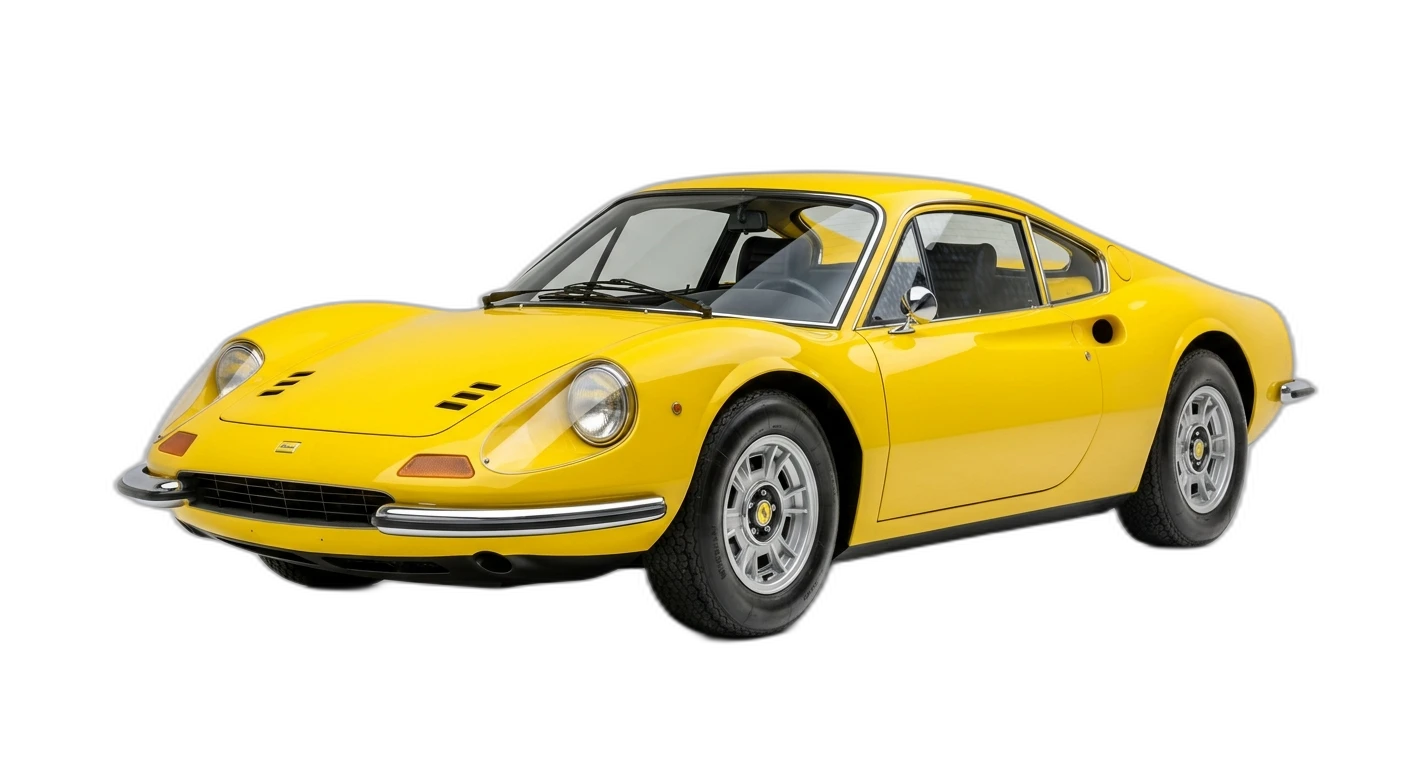
Named after Enzo Ferrari's son Alfredo 'Dino' who died at 24. The first mid-engine Ferrari road car. Originally sold without the Ferrari badge because Enzo considered a V6 unworthy of the prancing horse. Now universally recognized as one of the most beautiful Ferraris ever built.
History
Alfredo 'Dino' Ferrari, Enzo's only legitimate son, proposed a V6 engine design before dying of muscular dystrophy in 1956 at age 24. Enzo commissioned Fiat to produce the engine and Pininfarina to design the car as a tribute.
The Dino 206 GT debuted in 1967 with a 2.0-liter V6 and aluminum body. The definitive 246 GT followed in 1969 with a 2.4-liter iron-block engine producing 195 hp. Aldo Brovarone at Pininfarina drew one of the most sensuous shapes in automotive history: flowing curves, a delicate greenhouse, and proportions that made it look fast from every angle.
Enzo refused to put the Ferrari badge on the Dino, insisting that a V6 was beneath the marque. It was sold as simply 'Dino,' a separate brand. This decision, intended as a slight, accidentally created a mystique that made the car even more desirable.
The mid-engine layout, derived from Ferrari's Formula 2 racing cars, placed the V6 transversely behind the cockpit. It handled with a precision that the front-engine V12 Ferraris couldn't match, establishing mid-engine architecture as Ferrari's future.
2,732 Dino 246 GTs and GTSs were built. Today they command $300,000 to $500,000, and Ferrari has retroactively accepted them into the family. Every Dino is now a Ferrari.
Timeline
Production & Heritage
Value estimates are editorial assessments based on recent auction results and market trends.
Technical Specifications
Engine Details
Performance
Dimensions
Chassis & Suspension
Capacity
Source: Ferrari / Wikipedia
Tags
Designed by Pininfarina (Aldo Brovarone)
From the 1960s
Featured in
Featured in Collections
References & Sources


More in Sports
See all
356 Pre-A
356 Speedster
XK120