
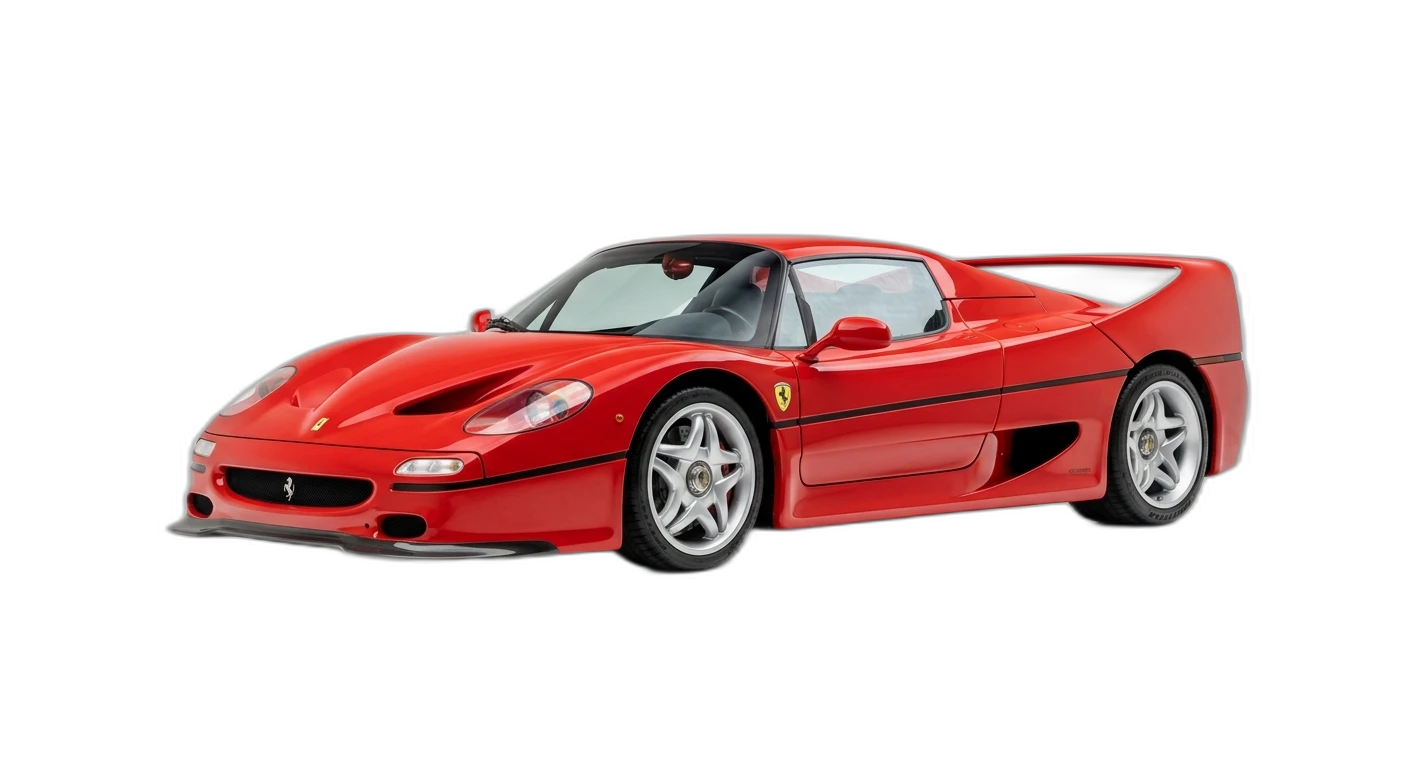
A Formula 1 V12 in a road car. The F130B engine was derived from Ferrari's 1990 F1 season 3.5-liter V12, enlarged to 4.7 liters. No power steering, no ABS, manual gearbox only. Bolted directly to the carbon-fiber monocoque as a stressed member. The analog hypercar, overshadowed by the F40 but now recognized as the purer driving experience.
History
The F50 was designed to be as close to a Formula 1 car as possible while remaining street-legal. The F130B V12 was directly derived from the engine Alain Prost used in the 1990 Ferrari 641 F1 car, enlarged from 3.5 to 4.7 liters. It revved to 8,500 rpm and produced 520 hp.
The engine was bolted directly to the carbon-fiber monocoque tub, serving as a structural member exactly as in an F1 car. The pushrod suspension was also F1-inspired, with inboard spring/damper units and rose joints.
Ferrari deliberately omitted power steering, ABS, and traction control. The F50 communicated every surface change through the steering wheel and every weight transfer through the seat. It was rawer than the F40 in some respects, despite being seven years newer.
Only 349 were built (one fewer than the F40's planned 400). Ferrari leased rather than sold the first batch to prevent speculation. That strategy failed: values have risen from $480,000 new to $3 to $5 million today.
The F50 was initially dismissed as inferior to the F40. Time has been kind: it is now widely considered the better driver's car, offering a purity of connection that the turbocharged F40 cannot match.
Timeline
Production & Heritage
Value estimates are editorial assessments based on recent auction results and market trends.
Technical Specifications
Engine Details
Performance
Dimensions
Chassis & Suspension
Capacity
Source: Ferrari / Wikipedia
Tags
Designed by Pininfarina (Lorenzo Ramaciotti)
From the 1990s
Featured in
Featured in Collections
References & Sources


More in Sports
See all
356 Pre-A
356 Speedster
XK120