
Beetle (Type 1)
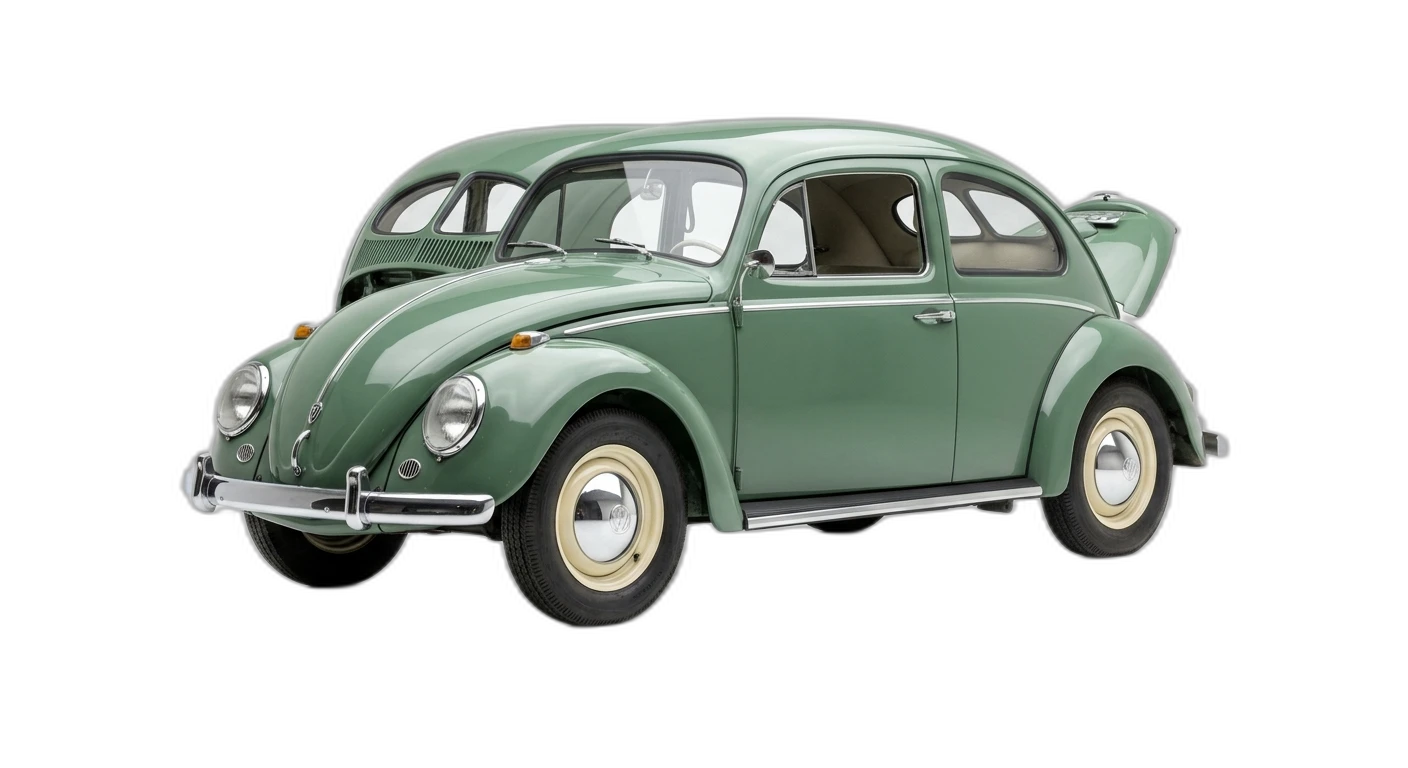
The most produced car in history: 21.5 million built. Ferdinand Porsche designed it as Hitler's people's car. After the war, British Army officer Ivan Hirst saved the Wolfsburg factory from demolition and restarted production. The Beetle became a symbol of economic recovery, counterculture, and democratic mobility.
History
Ferdinand Porsche designed the KdF-Wagen (Kraft durch Freude, 'Strength through Joy') in 1938 for the Nazi government's motorization program. The rear-engine, air-cooled layout was chosen for simplicity and reliability. No civilian KdF-Wagens were delivered before the war.
In 1945, British Army Major Ivan Hirst found the bombed Wolfsburg factory and recognized the car's potential. He ordered 20,000 Beetles for the British Army, saving both the factory and its workforce. No British manufacturer wanted to buy the factory. Hirst's decision to restart production is one of the most consequential in automotive history.
The Beetle's air-cooled flat-four engine, torsion bar suspension, and simple construction made it reliable in conditions that destroyed more sophisticated cars. It worked in African heat, Scandinavian cold, and Brazilian humidity. It could be maintained with basic tools.
By the 1960s, the Beetle had become the counterculture icon: Herbie, hippie vans, and Baja racing. DDB's 'Think Small' advertising campaign is considered the greatest ad campaign in history.
21,529,464 were built across 65 years of production, with the last one rolling off the Mexican production line in 2003. It surpassed the Ford Model T's record in 1972 and held the title of most-produced car until 2002.
Timeline
Production & Heritage
Value estimates are editorial assessments based on recent auction results and market trends.
Technical Specifications
Engine Details
Performance
Dimensions
Chassis & Suspension
Capacity
Source: Wikipedia, Volkswagen heritage
Tags
Designed by Ferdinand Porsche / Erwin Komenda
From the 1930s
Featured in
Featured in Collections
References & Sources


More in City
See all
500 (Nuova)