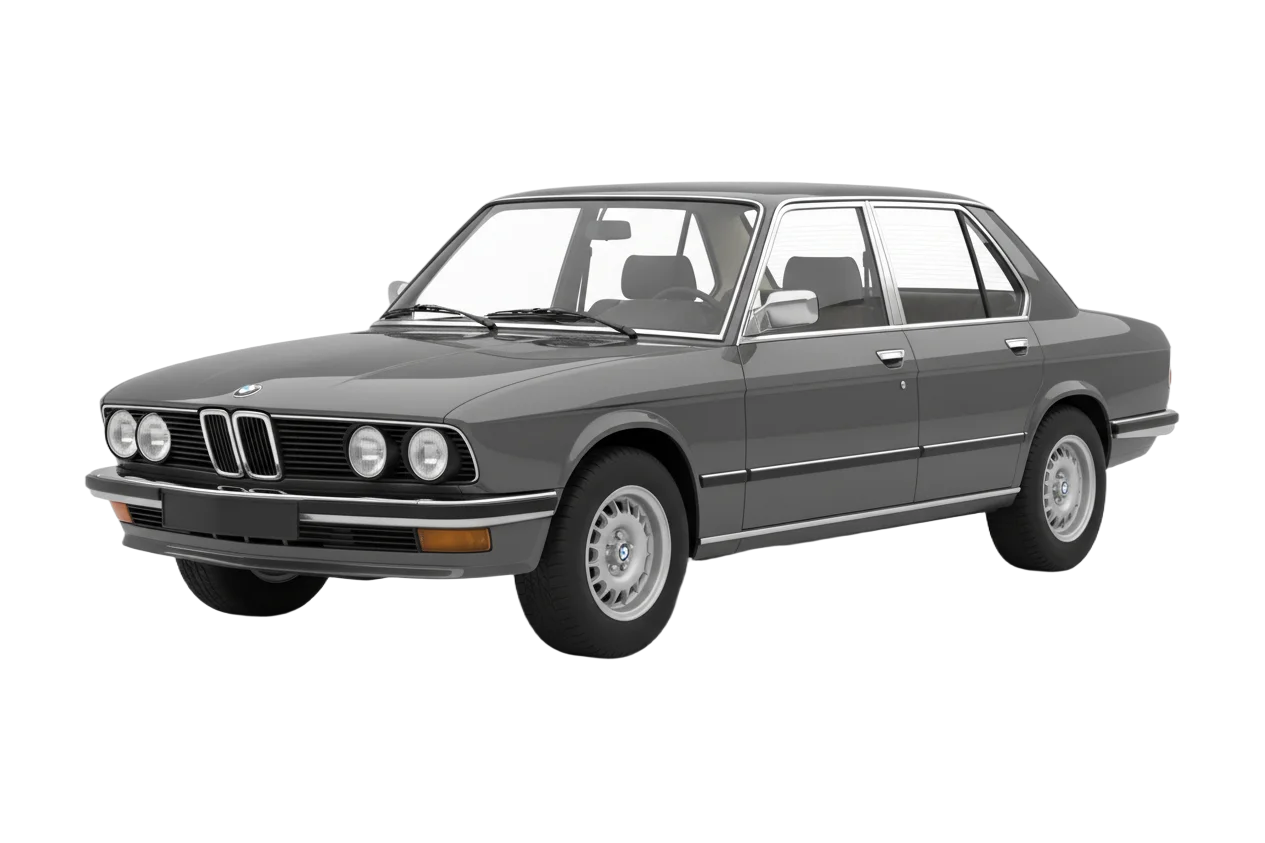
The BMW E12 was the first car to officially wear the 5 Series badge, establishing the executive sedan segment that would become a cornerstone of BMW's lineup. It defined the concept of a mid-size luxury car with genuine sporting character, a formula BMW would refine over the following decades.
History
The BMW E12, launched in 1972, inaugurated the 5 Series nameplate that would become one of the automotive industry's most enduring and successful model lines. Designed by Paul Bracq, the E12 replaced the New Class sedans (1500/1600/1800/2000) and was BMW's first model to adopt the new naming convention where the first digit indicated the series and the following digits denoted the engine displacement.
The E12 was offered with a range of inline-four and inline-six engines, from the entry-level 518 with its 1.8-liter four-cylinder to the range-topping 535i with a 3.5-liter six. The car introduced several engineering innovations for BMW, including a semi-trailing arm rear suspension with coil springs that provided a sophisticated balance of comfort and handling. Build quality was a step above the 02 Series, with more attention paid to noise, vibration, and harshness.
The E12's significance extends beyond its role as the first 5 Series. It was produced during a tumultuous period for the automotive industry, navigating the 1973 oil crisis and increasingly stringent emissions regulations, particularly in the United States. BMW managed to maintain the car's sporting character despite these challenges, offering fuel-injected variants that delivered strong performance while meeting regulatory requirements. The M535i variant, introduced in 1980, was the precursor to the legendary M5 and demonstrated that an executive sedan could offer genuine sports car performance.
Over its nine-year production run, nearly 700,000 E12s were built, establishing the 5 Series as a commercially viable pillar of BMW's product range. The E12 proved that there was a substantial market for a car that bridged the gap between compact sports sedans like the 2002 and full-size luxury cars, creating a segment that competitors would rush to fill. Today, E12s are relatively rare survivors that are gaining appreciation among collectors who value their clean design, mechanical simplicity, and historical importance.
Timeline
Production & Heritage
Value estimates are editorial assessments based on recent auction results and market trends.
Technical Specifications
Engine Details
Performance
Dimensions
Chassis & Suspension
Drivetrain
Capacity
Source: BMW AG / Wikipedia
Tags
Designed by Paul Bracq
From the 1970s
Featured in Collections
References & Sources


More in Sedan
See all
Traction Avant
DS 21 Pallas