The Roadster Revival: BMW's Z Cars from Z1 to Z8
Four letters, four decades, four completely different philosophies — how BMW's Z division explored what an open-top sports car could be.
The letter Z in BMW's nomenclature
The letter Z in BMW's nomenclature stands for Zukunft — German for "future." It's a fitting designation for a series of cars that each represented a different vision of what a two-seat sports car could be.
The Z1, launched in 1989, was the most experimental. Developed by BMW Technik GmbH — the company's advanced engineering skunkworks — it featured doors that dropped vertically into the body sills rather than swinging outward. The mechanism was complex, unreliable, and absolutely wonderful. You could drive the Z1 with the doors down, wind rushing past at waist height, in an experience no other production car has replicated.
Harm Lagaay designed the body using removable thermoplastic panels bolted to a zinc-coated steel monocoque. In theory, you could change the Z1's color by swapping its body panels — a concept decades ahead of its time. The M20 inline-six produced a modest 170 hp, but at just 1,250 kg, the Z1 was nimble enough to make the most of it.
Only 8,000 were built, and the
Only 8,000 were built, and the Z1 was never officially sold in the United States. It remains the rarest modern BMW, and clean examples command $70,000-90,000 — remarkable for a car that cost DM 83,000 when new.
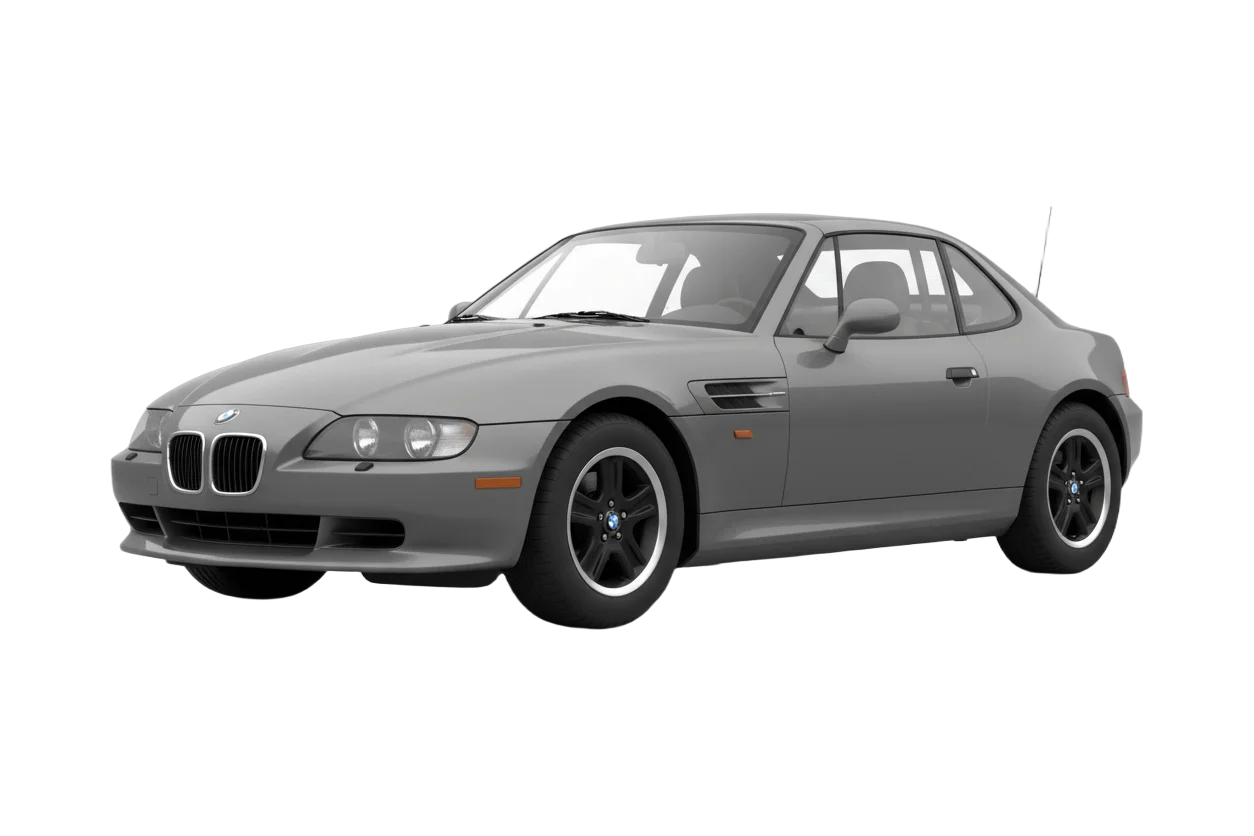
The Z3 arrived in 1995 and took the opposite approach. Where the Z1 was an engineering exercise, the Z3 was a marketing masterpiece. Built at BMW's new Spartanburg plant in South Carolina, it was positioned as an accessible roadster — the MX-5's premium alternative. A GoldenEye appearance launched it into pop culture before the first customer car was delivered.
The Z3 M Roadster, with its S52 (US) or S50 (Europe) inline-six, offered genuine performance. The wide rear fenders and aggressive stance made it look like a different car entirely from the standard four-cylinder version. Over 279,000 Z3s were sold — proof that the BMW roadster concept had mass-market appeal.
The Z4 E85 (2002) swung the
The Z4 E85 (2002) swung the pendulum toward aggression. Anders Warming's design — featuring Chris Bangle's controversial flame-surfacing — replaced the Z3's curves with sharp creases and muscular surfaces. The car looked angry. The 3.0-liter inline-six was one of BMW's finest, and the optional SMG sequential manual added a racing dimension.
The Z4 E89 followed in 2009 with a retractable hardtop, transforming from coupe to roadster in 20 seconds. It was more practical, more refined, and — to some enthusiasts — less characterful than the E85.
And then there was the Z8. Henrik Fisker's aluminum masterpiece sat above the Z-car hierarchy entirely. With its hand-built chassis, M5-sourced V8, and $128,000 price tag, the Z8 was a different species. It proved that BMW could build a world-class grand tourer that happened to be a roadster.
The Z-car lineage shows BMW at
The Z-car lineage shows BMW at its most exploratory: from thermoplastic panels to retractable hardtops, from 170 hp to 400 hp, from experimental oddity to cultural icon. Each Z car asked a different question about what a roadster should be. None of them arrived at the same answer.
Written by Singular Heritage Team
Published November 9, 2025 · 7 min read
Part of the Singular Heritage network