The Pagani Zonda: When One Man's Obsession Became a Masterpiece
Horacio Pagani left Argentina with a dream, apprenticed under Lamborghini, and spent twelve years building the car that no major manufacturer would dare attempt.
Horacio Pagani arrived in Modena, Italy,
Horacio Pagani arrived in Modena, Italy, in 1983 with a suitcase, limited Italian, and an introduction to Lamborghini. He was 28 years old, from a modest family in Casilda, Argentina, and he had exactly one credential: a composite-material racing car body he had built in his parents' garage using techniques he taught himself from aerospace textbooks.
Lamborghini hired him. Within a few years, Pagani had become the company's composite materials specialist, pioneering the use of carbon fiber in the Countach 25th Anniversary Edition and the Diablo. But Pagani wanted to build his own car — and in 1988, he began working on what he called "Project C8" in the evenings and weekends.
The concept was ambitious: a mid-engine supercar built entirely from carbon fiber, combining Italian craftsmanship with the structural precision of aerospace engineering. No major manufacturer had attempted a full carbon-fiber monocoque road car since the McLaren F1. Pagani wasn't a major manufacturer. He was one man with a workshop.
By 1992, Pagani had left Lamborghini
By 1992, Pagani had left Lamborghini to focus on his project full-time. He founded Modena Design, a composite engineering consultancy, to fund the development. The income from building components for Ferrari, Lamborghini, and Dallara kept the lights on while the C8 progressed.
The engine came from an unlikely source. Pagani persuaded Mercedes-AMG to supply their M120 V12 — a 6.0-liter unit tuned specifically for the Zonda. Juan Manuel Fangio, the Argentine five-time Formula 1 world champion and a Mercedes-Benz ambassador, reportedly helped broker the introduction. Fangio died in 1995, before the car reached production, but Pagani named it in tribute: "Zonda," after a warm wind that blows across the Argentine pampas.
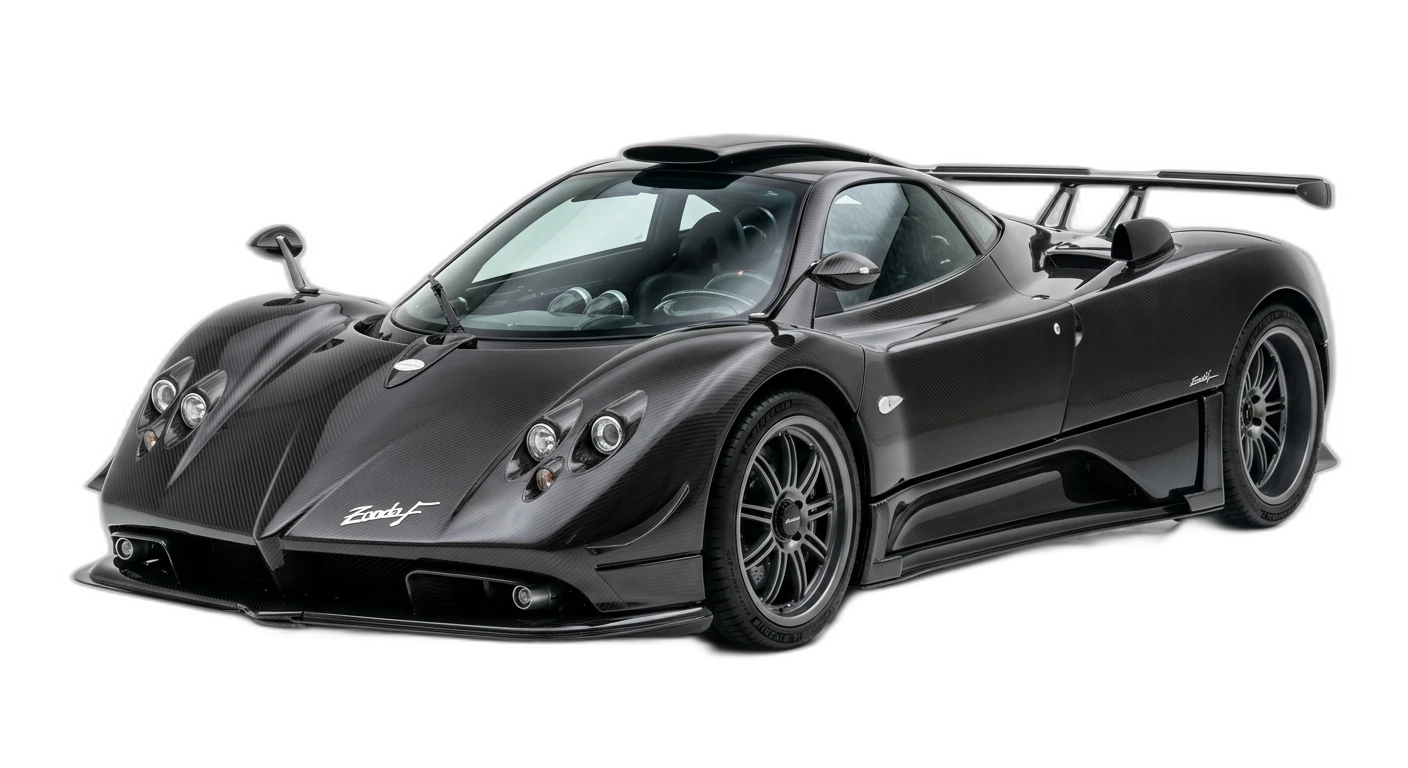
The Zonda C12 debuted at the 1999 Geneva Motor Show. It weighed 1,250 kg — lighter than a Porsche 911 Turbo. The carbon-fiber monocoque was not just structural; it was visible through glass panels in the floor and engine bay, treated as an aesthetic element. Every mechanical component was exposed where possible. The quad exhaust pipes rose from the engine bay like organ tubes.
The Zonda evolved through a decade
The Zonda evolved through a decade of variants: the C12 S (7.0-liter), the C12 S Monza (track-focused), the F (the definitive road car), the Cinque (limited to five units), and the R (a track-only weapon). Each was faster, lighter, and more extreme than the last. The Zonda F, with its 602 hp Mercedes V12 and 1,230 kg curb weight, could lap the Nurburgring in 7:27.
What set the Zonda apart from every other supercar was its obsessive attention to detail. Pagani machined his own titanium bolts because commercially available fasteners weren't beautiful enough. The interior leather was hand-stitched in patterns that took weeks to complete. The aluminum shift knob was milled from a single billet. Every Zonda was hand-built by a team of fewer than 40 people in San Cesario sul Panaro, a village south of Modena.
Pagani produced approximately 140 Zondas across all variants. Each one has appreciated dramatically — the Zonda F, which cost around EUR 600,000 new, now commands EUR 2-4 million at auction.
The Zonda's legacy isn't just commercial
The Zonda's legacy isn't just commercial — it's philosophical. Horacio Pagani proved that one person, with sufficient obsession and craftsmanship, could build a car that stood alongside Ferrari and Lamborghini. No business school would have approved his plan. No focus group would have predicted the result. The Zonda exists because one man believed that carbon fiber could be sculpted into art, and then spent twelve years proving it.
Written by Singular Heritage Team
Published September 1, 2025 · 9 min read
Part of the Singular Heritage network