
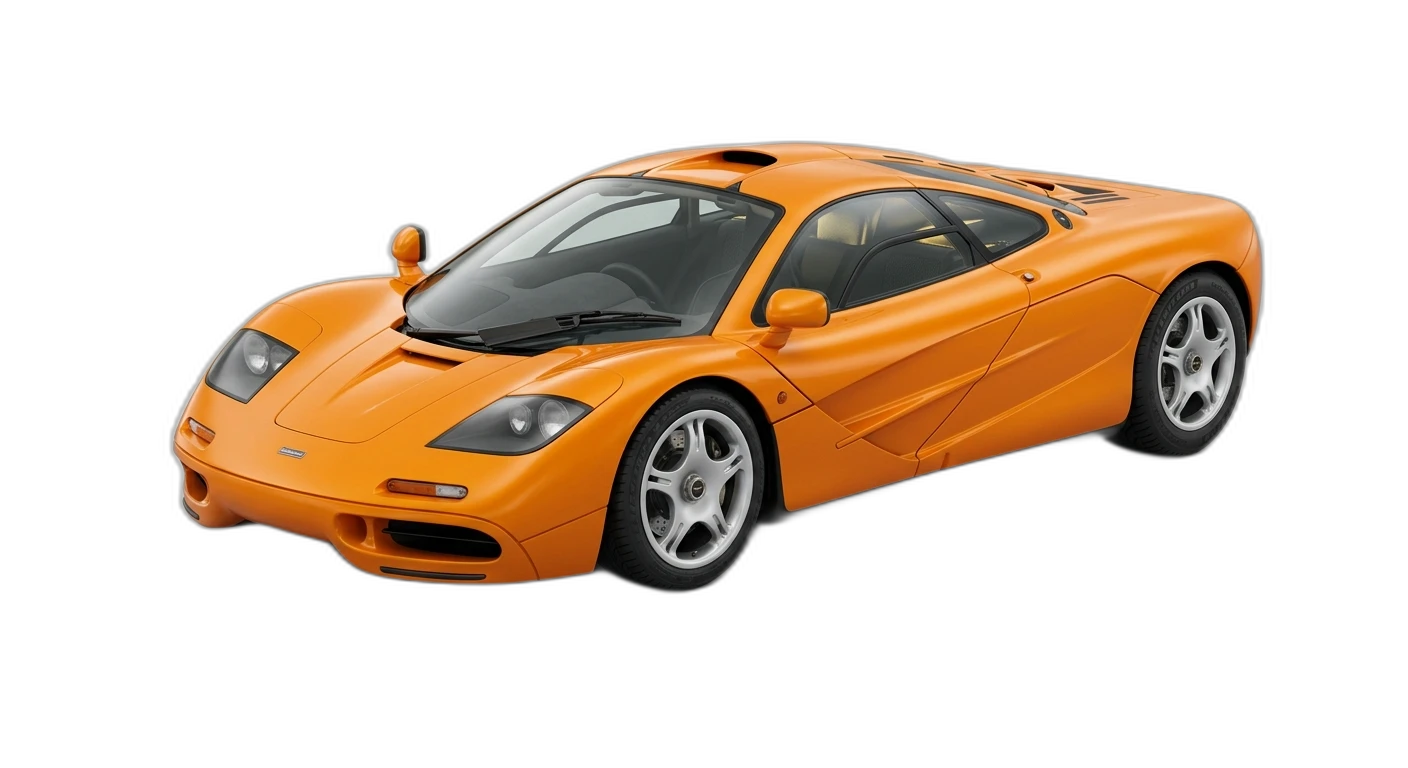
The greatest car ever built. Gordon Murray's obsession with lightweight engineering produced a carbon-fiber monocoque supercar with a BMW V12, center driving position, gold-foil engine bay lining, and a top speed of 240 mph that stood as a record for over a decade.
History
Gordon Murray spent his career at Brabham and McLaren designing Formula 1 cars. The F1 was his vision of the ultimate road car, conceived without compromise and built without regard for cost.
The center driving position was inspired by Murray's experience in single-seaters. The passenger seats flanked the driver, slightly behind and lower, giving the driver perfect visibility and symmetrical control inputs. No other production car has replicated this layout.
The BMW S70/2 V12 was designed by Paul Rosche at BMW Motorsport specifically for the F1. It was naturally aspirated, producing 627 hp at 7,400 rpm from 6.1 liters. Murray insisted on natural aspiration because turbo lag was incompatible with his vision of throttle response. The engine weighed just 266 kg.
The carbon-fiber monocoque was the first in a road car. The engine bay was lined with gold foil for heat reflection. The body used no wings or spoilers, relying instead on ground-effect aerodynamics generated by a fan-assisted diffuser.
Only 106 were built: 64 road cars, 5 LM models, 3 GT models, 28 GTR race cars, and 6 prototypes. The F1 won Le Mans in 1995 on its first attempt, beating purpose-built prototypes.
Values have exceeded $20 million at auction, making the F1 one of the most valuable cars in existence.
Timeline
Production & Heritage
Value estimates are editorial assessments based on recent auction results and market trends.
Technical Specifications
Engine Details
Performance
Tags
Designed by Peter Stevens / Gordon Murray
From the 1990s
Featured in
Featured in Collections
References & Sources


More in Sports
See all
356 Pre-A
356 Speedster
XK120