
Diablo VT
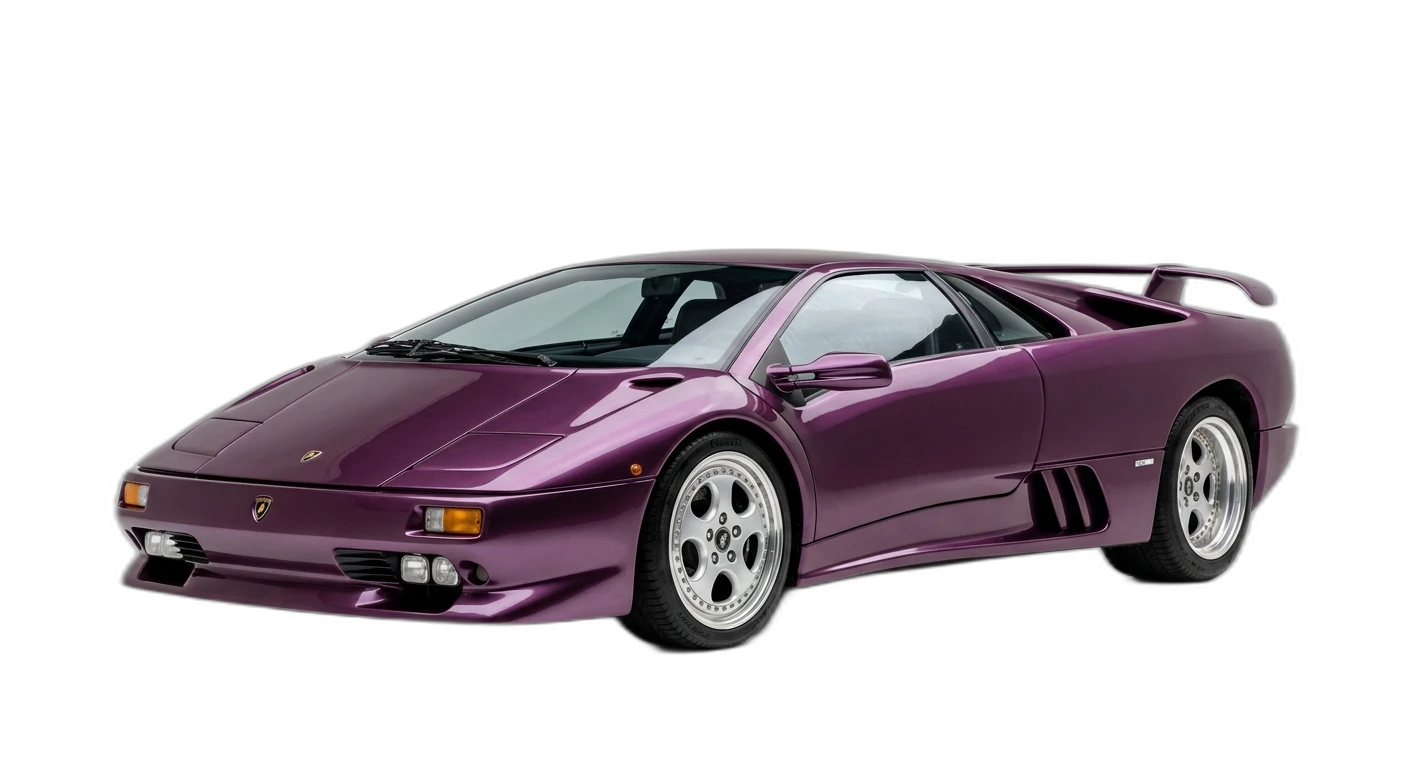
The Diablo VT introduced all-wheel drive to Lamborghini's flagship supercar, taming the original rear-drive Diablo's fearsome handling while retaining its dramatic presence and V12 performance. It made the Diablo accessible to a wider range of drivers while maintaining its position as one of the world's fastest production cars.
History
The Lamborghini Diablo VT, launched in 1993, represented a crucial evolution of the Diablo supercar that had debuted three years earlier. The 'VT' designation stood for Viscous Traction, referring to the viscous-coupling center differential that distributed power between the front and rear axles. This all-wheel-drive system was developed to address the original rear-drive Diablo's reputation for challenging handling at the limit, a characteristic that had earned the car respect among skilled drivers but also contributed to a number of high-profile incidents.
The VT's viscous coupling system normally directed the majority of the engine's torque to the rear wheels, only sending power forward when the rear tires began to lose traction. This approach preserved the Diablo's rear-drive character during normal driving while providing a crucial safety net during aggressive acceleration or in adverse conditions. The 5.7-liter V12 engine, producing approximately 492 horsepower in initial form and later increasing to 530 horsepower in the updated VT 6.0, drove through a five-speed manual gearbox with the characteristically heavy and deliberate shift action that defined Lamborghini's manual transmissions.
The Diablo VT underwent significant updates during its production life. The most notable revision came in 1999 with the Diablo VT 6.0, which featured a redesigned front end with fixed headlights replacing the pop-up units, updated taillights, revised interior trim, and the enlarged 6.0-liter engine that boosted power and torque significantly. These changes, introduced after Audi's acquisition of Lamborghini, reflected the German company's influence on build quality and refinement while preserving the Diablo's essential Italian character and visual drama.
Total production of all Diablo VT variants reached approximately 2,903 units over the model's eight-year run, making it the most produced Diablo variant. The VT established all-wheel drive as a core element of Lamborghini's supercar formula, a philosophy that continues through the Murcielago, Aventador, and Revuelto. The Diablo VT also holds cultural significance as one of the defining supercars of the 1990s, its extreme wedge profile, scissor doors, and howling V12 embodying an era of unapologetic automotive excess. Today, well-maintained examples are appreciating rapidly as collectors recognize the Diablo VT as the last of the truly analog Lamborghini flagships.
Timeline
Production & Heritage
Value estimates are editorial assessments based on recent auction results and market trends.
Technical Specifications
Engine Details
Performance
Dimensions
Chassis & Suspension
Capacity
Source: Lamborghini / Wikipedia
Tags
Designed by Marcello Gandini
From the 1990s
Featured in
Featured in Collections
References & Sources


More in Sports
See all
356 Pre-A
356 Speedster
XK120