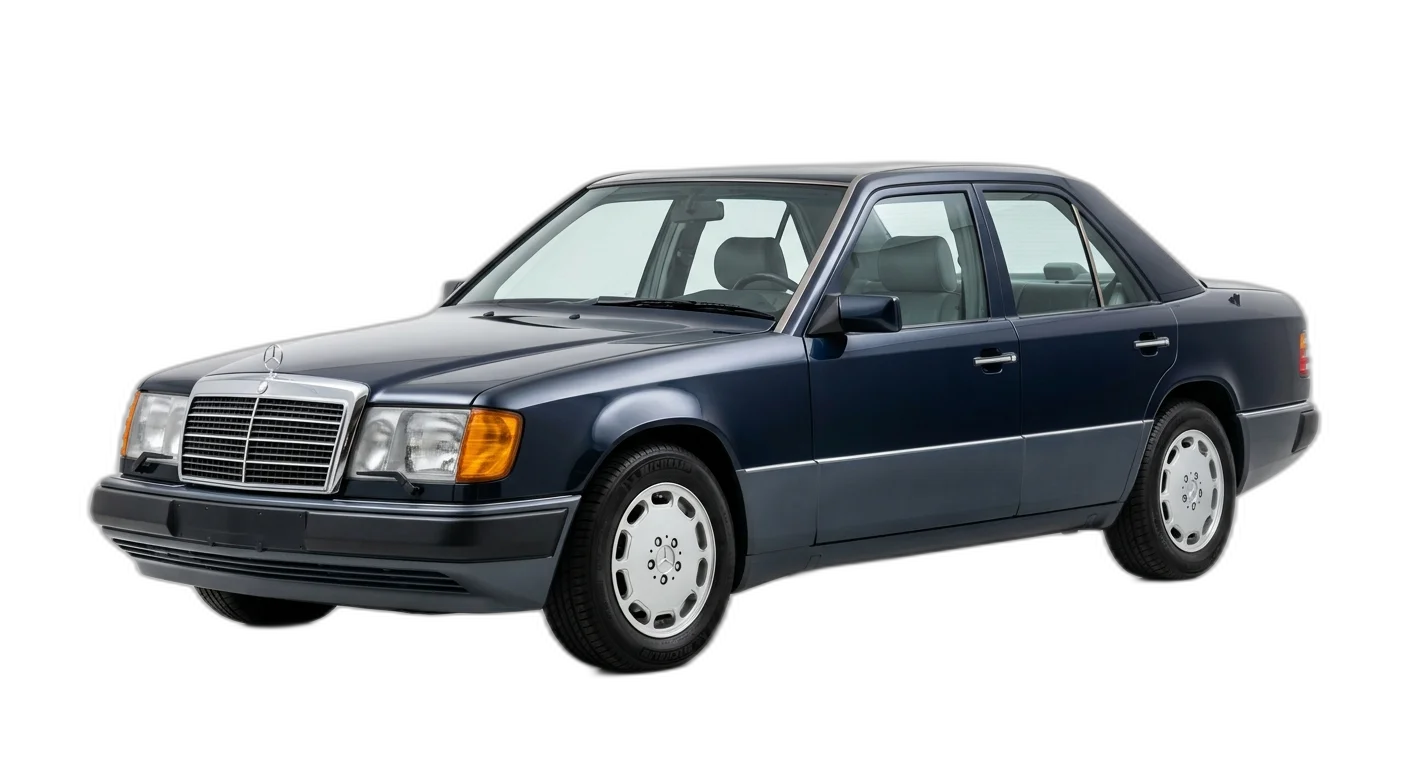
The Mercedes W124: The Last Car Built to Last Forever
Mercedes-Benz spent over a billion Deutschmarks developing the W124. Then they built it to survive decades. The accountants never forgave them.
In the 1980s, Mercedes-Benz engineers op...
In the 1980s, Mercedes-Benz engineers operated under a principle that would be considered financial negligence today: build the car so well that the customer never needs to replace it.
The W124 E-Class, produced from 1984 to 1997, was the zenith of this philosophy. It was the last Mercedes designed before cost-cutting became a corporate priority, and the engineering borders on the obsessive.
The body panels were zinc-coated on both sides — a rust protection treatment so thorough that W124s in northern Europe, where salt corrodes lesser cars within a decade, routinely survive 30+ years with original metal. The gaps between panels were measured to 3mm tolerances across the entire body. The doors closed with a precision thunk that became Mercedes-Benz's acoustic signature.
The paint was applied in a
The paint was applied in a multi-stage process that included cathodic dip coating, primer, basecoat, and clearcoat — then baked at temperatures that would warp modern water-based paints. W124 paintwork, properly maintained, retains its depth and gloss after three decades of UV exposure.
Under the skin, the engineering was equally uncompromising. The multi-link rear suspension — a Mercedes-Benz innovation — used five separate arms per wheel, each controlling a different axis of movement. This gave the W124 handling precision that contradicted its executive-car weight. The system was so effective that BMW spent the next decade trying to match it.
The engines were bulletproof. The M103 inline-six and M104 that followed it were designed for 300,000+ km service lives. The OM603 inline-six diesel was even more durable — taxi operators in Germany routinely logged over a million kilometers on original engines.
The 500E (later E500) — developed
The 500E (later E500) — developed secretly with Porsche in Zuffenhausen — was the ultimate W124. Each 500E was partially assembled at Porsche's factory: the V8 engine was installed, the suspension was fitted, and the widened body panels were aligned before the car was shipped back to Mercedes for final assembly. The process took 18 days per car. It was wildly inefficient and magnificently excessive.
The W124's successor, the W210 E-Class, launched in 1995 to critical acclaim and early rust problems. Mercedes had begun cutting costs. The W210's paint was thinner, its corrosion protection less comprehensive, its interior materials cheaper. The contrast with the W124 was stark — and customers noticed.
Today, clean W124s are appreciating. The 500E commands $50,000 to $100,000 for the best examples. Even standard sedans in good condition sell for $15,000 to $30,000 — remarkable for a car that was once considered merely a good used Mercedes. The market is recognizing what W124 owners always knew: this was the last Mercedes built without asking what it would cost.
Written by Singular Heritage Team
Published September 12, 2025 · 8 min read
Part of the Singular Heritage network